
Trading Hyperliquid Perpetuals: A Practical Guide
A perpetual future is a derivative that tracks an asset's price and never expires. It is the dominant instrument in crypto trading because it lets you take leveraged exposure — long or short — without ever holding the underlying asset or rolling a contract forward. This guide covers how perpetuals work, what funding rates actually are, how margin and liquidation behave, and how to trade them on Hyperliquid through Rayze.
What is a perpetual future?
A traditional futures contract has an expiry date. You agree to a price now for settlement later, and when the date arrives the contract settles and disappears. If you want continued exposure you open a new contract — rolling — which costs money and attention.
A perpetual future removes the expiry. The position stays open until you close it or it is liquidated. That single change is why perpetuals dominate crypto trading volume: a trader with a directional view can hold it for an hour or a year without administrative friction.
Removing expiry creates a problem, though. A dated future converges to the spot price naturally, because on the settlement date the two must agree. With no settlement date, nothing forces a perpetual's price to track the asset it is supposed to represent. That is the problem funding rates exist to solve.
Funding rates: the mechanism that holds the peg
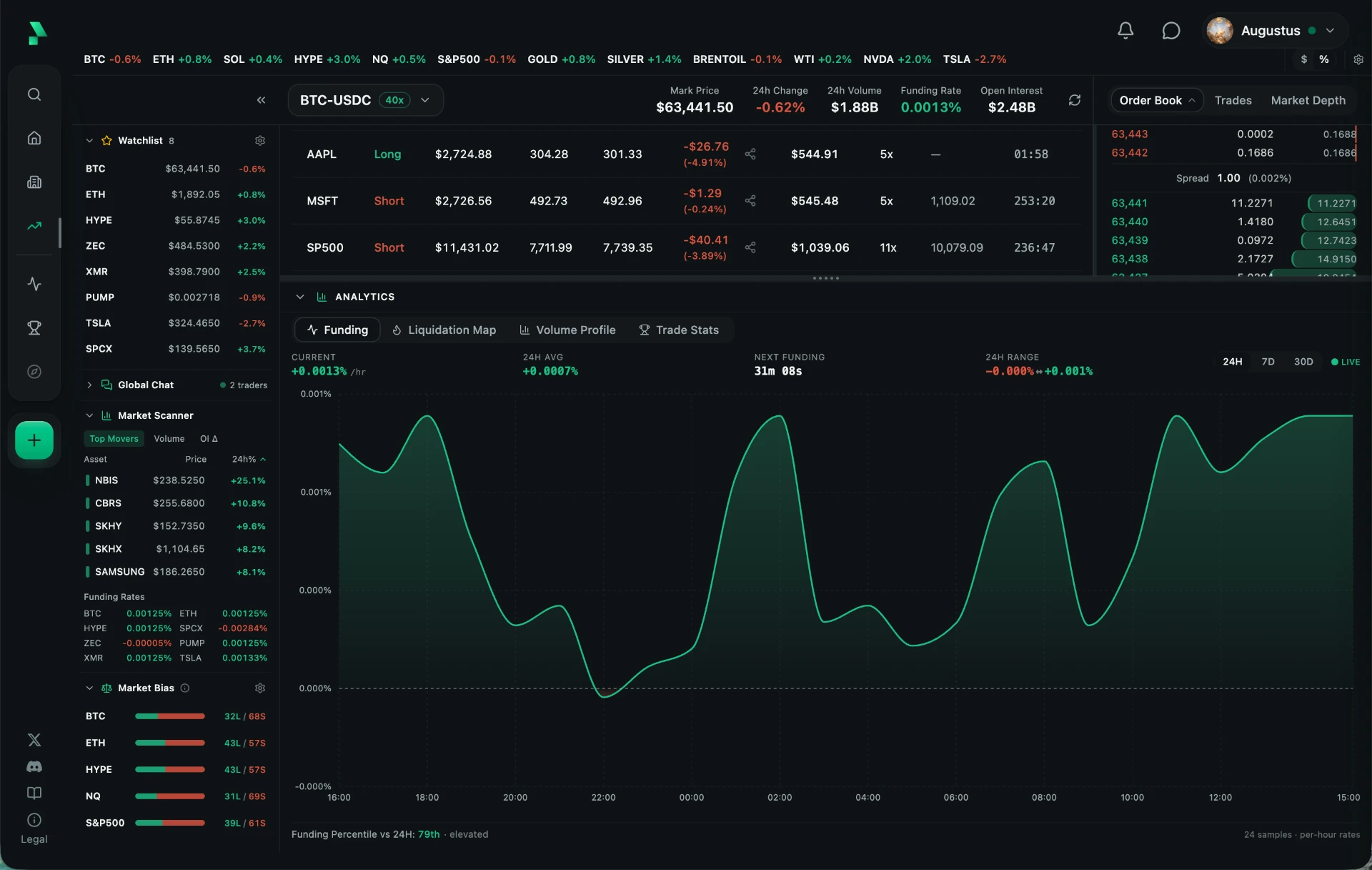
Funding is a recurring payment between traders on opposite sides of the market. It is not a fee the exchange charges — it moves from one set of traders to another, and it is the mechanism that keeps the perpetual's price anchored to spot.
The logic is a feedback loop. When the perpetual trades above spot, longs pay shorts. Holding a long becomes more expensive and shorting becomes more attractive, which pushes the price back down. When the perpetual trades below spot, shorts pay longs and the pressure runs the other way. The rate is recalculated regularly and settles on a schedule, so it accrues continuously rather than arriving as one charge.
For a trader, the practical consequence is that funding is a real cost or a real income stream, not a rounding error. A position held through a period of heavily one-sided positioning can pay or receive meaningfully, and on a leveraged position that flow is amplified relative to the margin you posted. A strategy that looks profitable on price movement alone can be unprofitable after funding — which is why it is worth checking the funding history for a market before holding a position in it for any length of time, not only the chart.
Margin, leverage, and liquidation
Leverage lets you control a position larger than the capital you post. The capital you post is margin. At 10x, $1,000 of margin supports a $10,000 position — and a 10% move against you erases the margin entirely.
That is what liquidation is. When losses consume your margin beyond a maintenance threshold, the position is force-closed to prevent the account going negative. The price at which this happens is knowable in advance, and it is the single most useful number on the screen when you open a leveraged position. If you do not know your liquidation price, you do not know your actual risk.
Maximum leverage is not uniform. It varies by asset, and it is generally lower on assets that are more volatile or less liquid — precisely the ones where a violent move is most likely. That constraint is a risk control, not an inconvenience.
Isolated vs. cross margin
Margin mode decides which capital is at risk when a position moves against you, and it is one of the more consequential settings a new trader tends to leave on the default.
In isolated margin, a position is backed only by the margin explicitly assigned to it. If it liquidates, you lose that margin and nothing else. Each position is walled off from the rest of the account.
In cross margin, positions share the account's balance as collateral. Unrealised profit on one position can support another, which makes liquidation less likely on any individual position — but a bad enough loss can reach the whole account rather than a single position's allocation.
Neither is universally correct. Isolated caps the damage from any single idea, which suits speculative positions and testing a new strategy. Cross is more capital-efficient for a portfolio of related positions, and demands more attention. The important thing is knowing which one you are using before the market moves, not after.
What Hyperliquid is, and why an on-chain perp venue differs
Hyperliquid is an on-chain perpetuals exchange with an order book. That combination is the notable part: order-book trading has historically meant a centralised exchange, where your funds sit with the venue and its internal state is something you take on trust.
On an on-chain venue the order book and settlement are visible and verifiable rather than reported to you. You are not asking whether the exchange's numbers are accurate — the record is public. Positions and trades are attributable to addresses, which is precisely what makes a verifiable trading record possible in the first place.
The practical trade-off is honest: on-chain venues are constrained by the infrastructure they run on in ways centralised matching engines are not, and self-custody means no support desk can reverse your mistake. What you get in exchange is a market whose state you can independently check.
Trading Hyperliquid perpetuals on Rayze
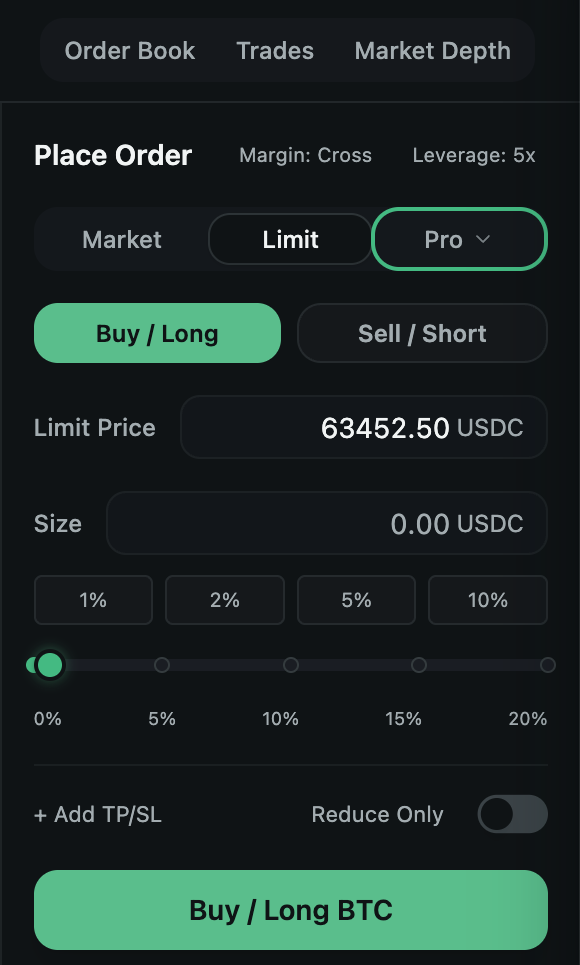
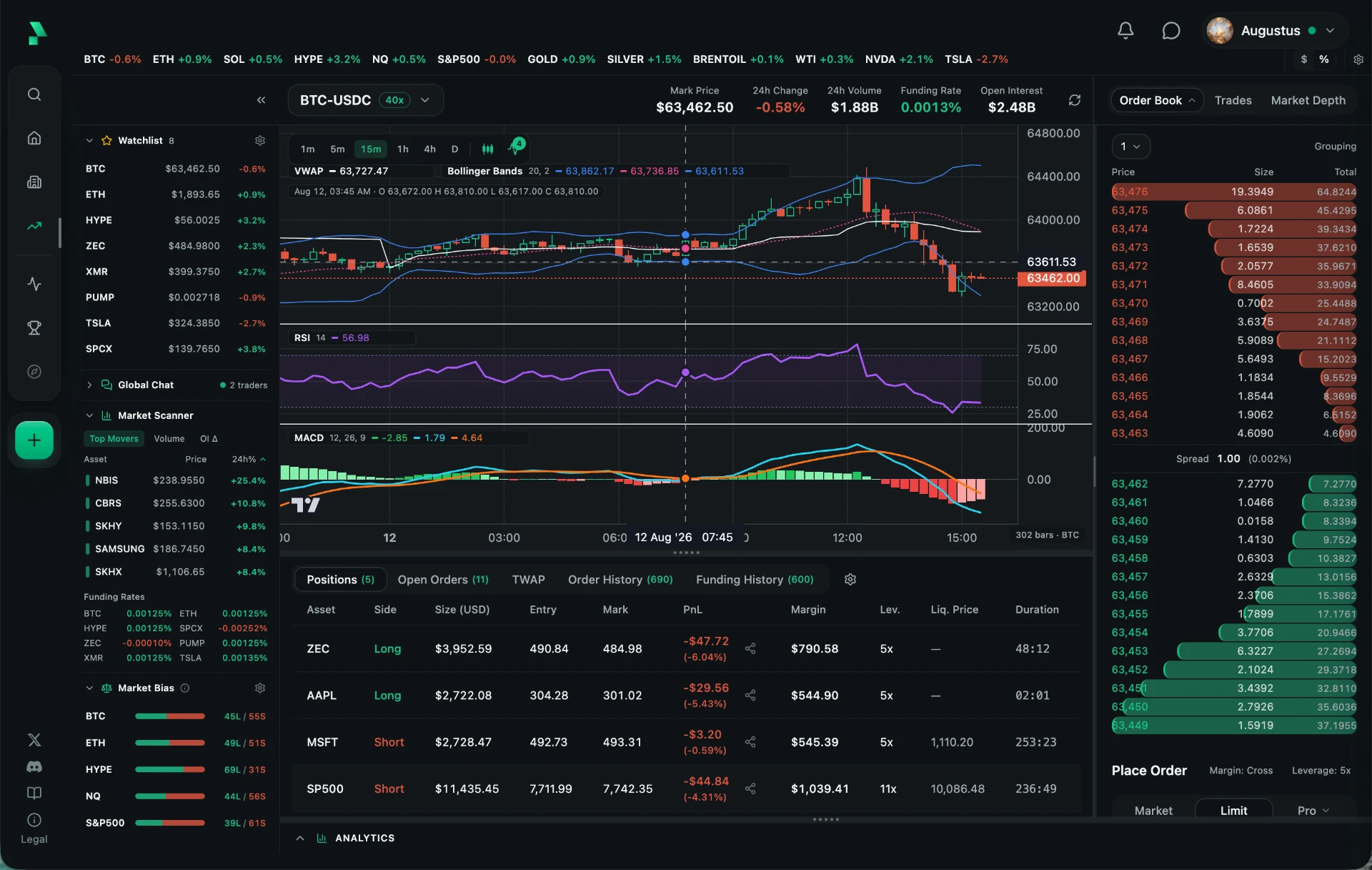
Rayze provides a full trading terminal on top of Hyperliquid, with live market data, an order book, charting, and a market scanner for finding what is moving.
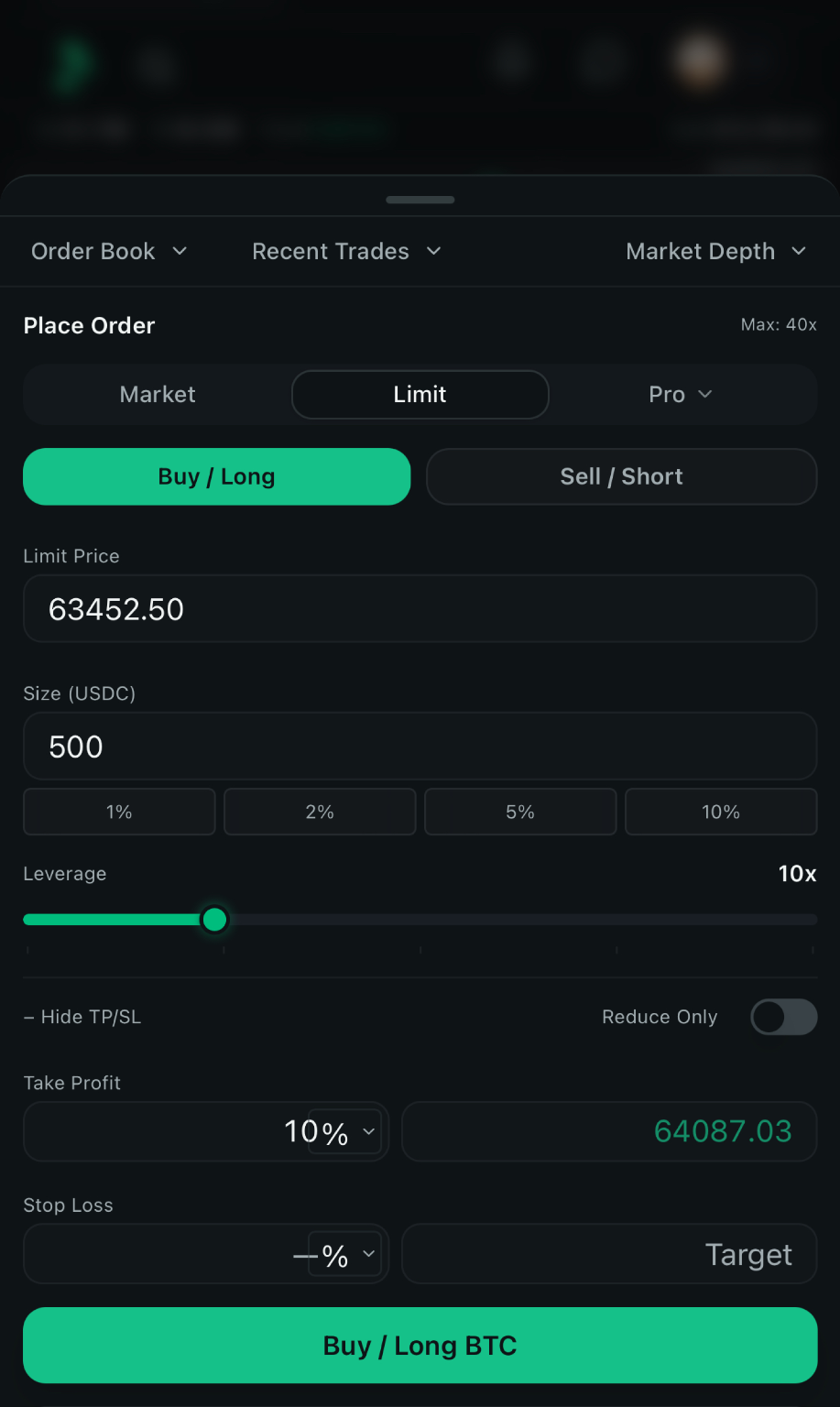
You can place market orders for immediate execution, limit orders at a price you choose, and trigger orders that activate when the market reaches a level — the building block for stops and take-profits. Leverage is set per position within each asset's maximum, and margin mode is yours to choose. The watchlist covers crypto alongside stocks, indices, and commodities, so the same account and the same interface handle markets that would traditionally require separate venues.
The part that does not exist elsewhere is what the terminal can trade on behalf of. The same interface trades your own account or, if you operate a fund, that fund's treasury. An operator does not learn one tool for personal trading and a different one for running capital on behalf of others — it is the same terminal, pointed at different capital.
Every trade a fund places is visible to the people invested in it as it happens, which is the connection back to how Rayze works generally: the trading surface and the transparency are not separate features.
The same terminal on a phone
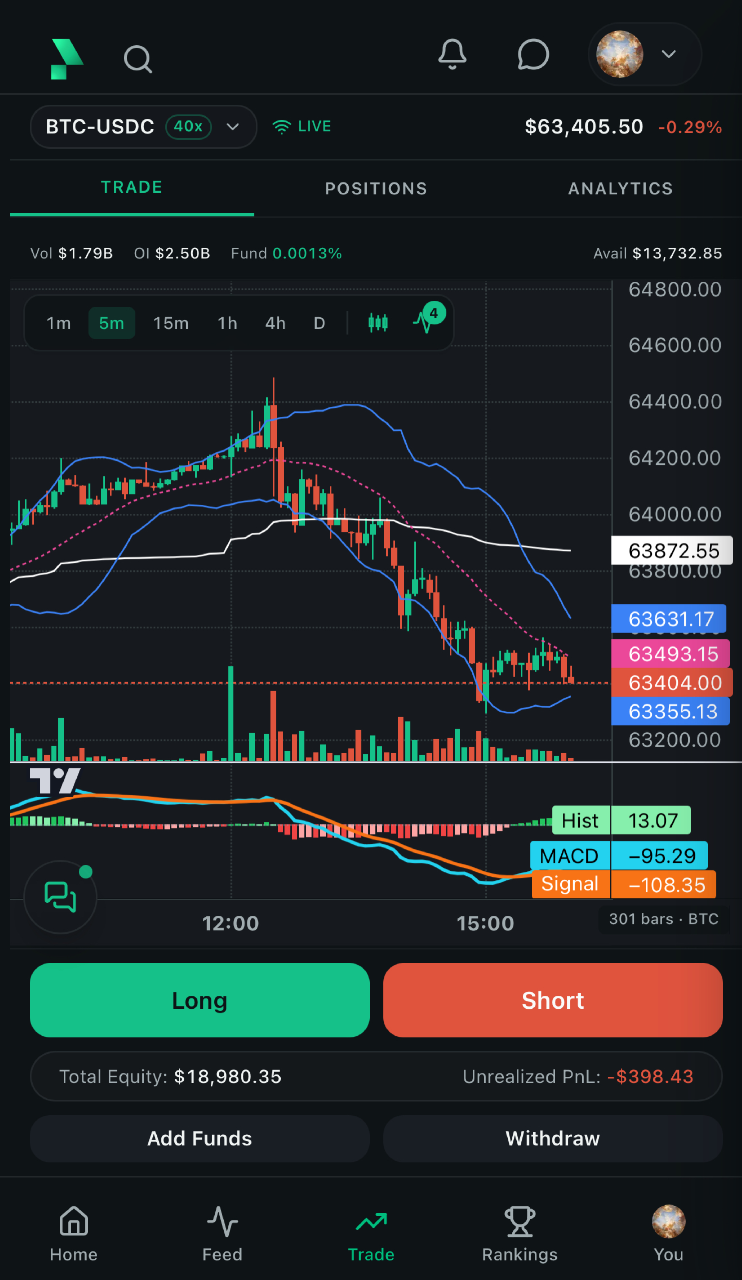
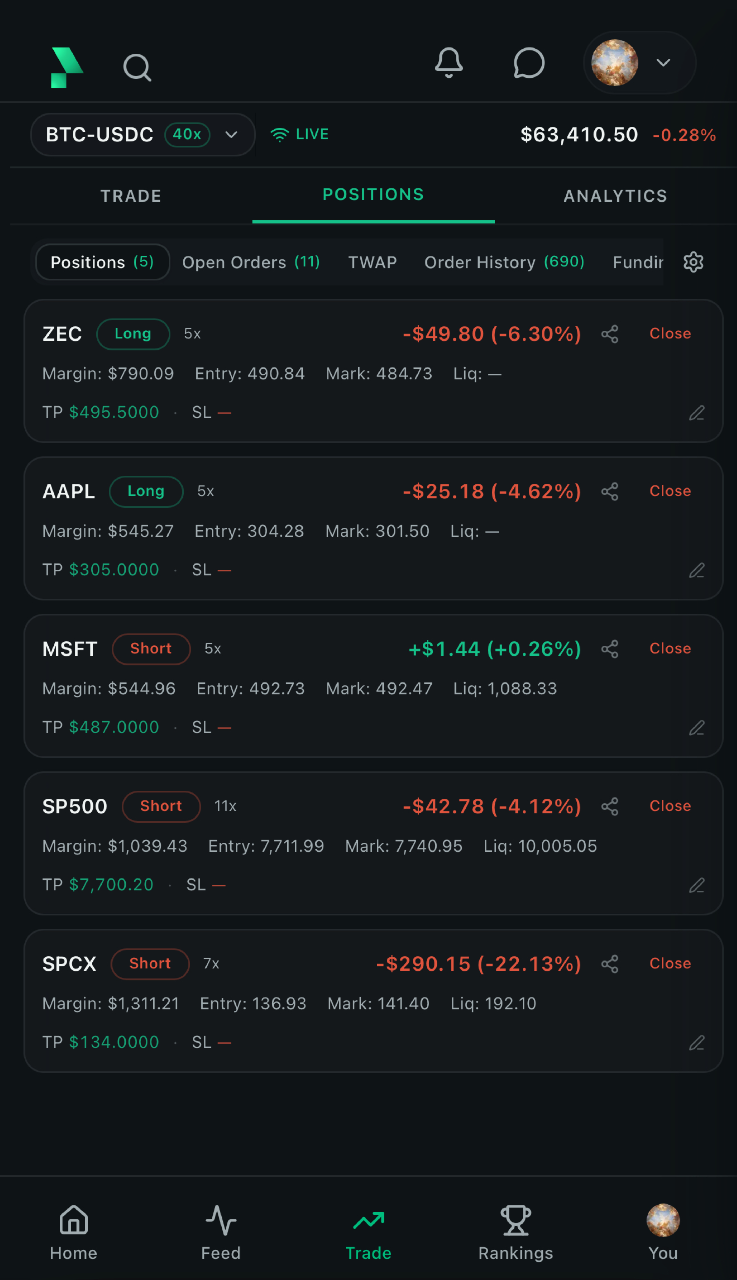
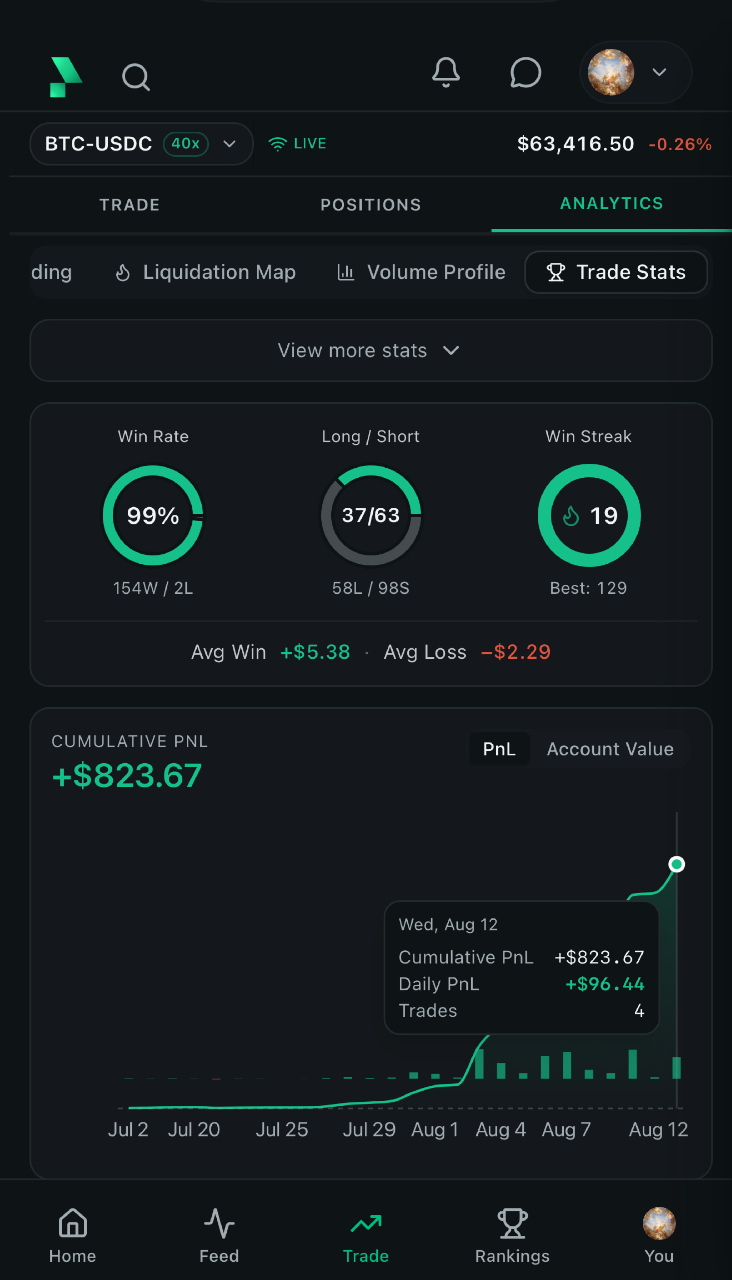
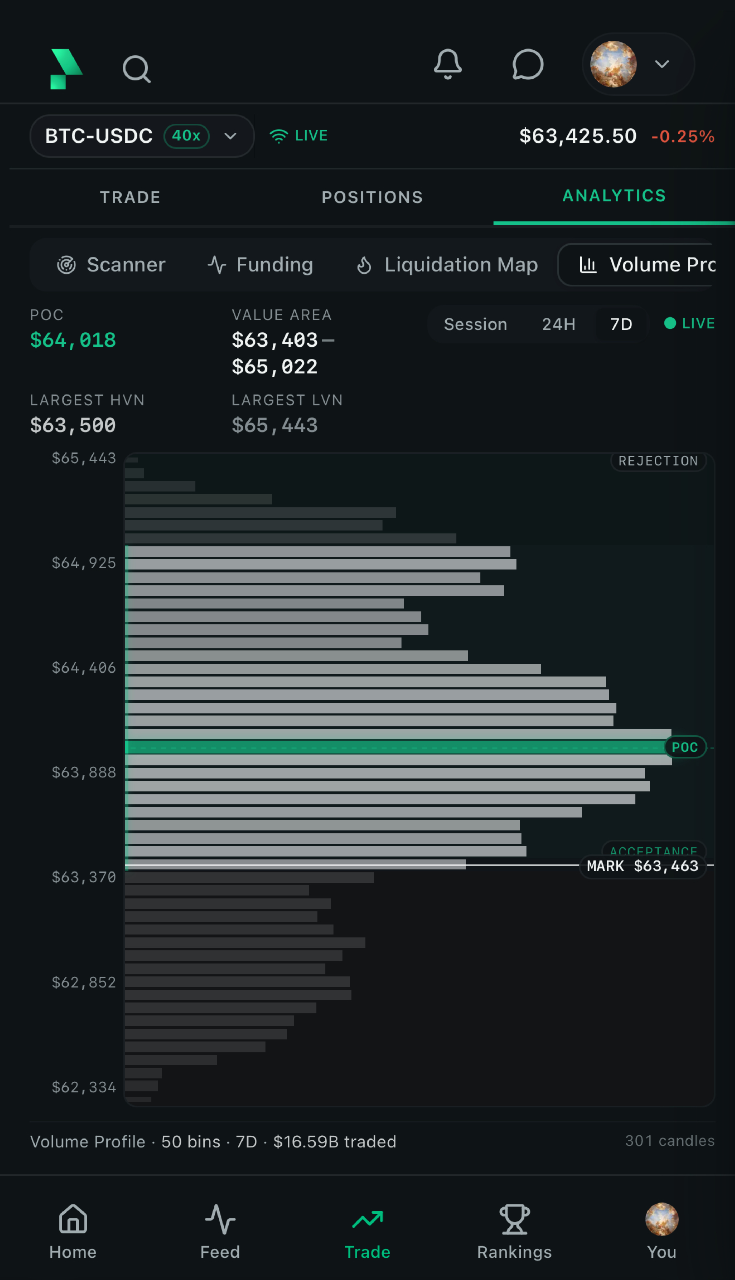
Every surface above is available on mobile: the chart and its indicators, long and short entry, your open positions, and the analytics that sit behind them.
Positions carry the same fields on a phone as on desktop, so margin, leverage and liquidation price stay in front of you wherever you are trading from.
Risks you should be clear about
Leveraged perpetual trading is among the higher-risk activities in retail finance, and most people who attempt it lose money. That framing is worth keeping regardless of how good the tooling is.
Leverage magnifies losses exactly as it magnifies gains, and liquidation is permanent — a position closed at your liquidation price does not recover when the market comes back an hour later. In fast markets, slippage and gaps mean the price you exit at can be worse than the level you expected.
Funding is a persistent drag on a position held against the prevailing bias, and it compounds. Self-custody means an error is final: no intermediary will reverse a transaction or restore an account. And on-chain venues carry smart-contract risk, which is not eliminated by the venue being transparent.
None of this is an argument against trading perpetuals. It is an argument for sizing positions on the assumption that you will sometimes be wrong.
Frequently asked questions
- What is a perpetual future?
- A perpetual future is a derivative that tracks an asset's price and never expires. Unlike a dated futures contract, there is no settlement date and nothing to roll — the position stays open until you close it or it is liquidated. It lets you take leveraged long or short exposure without holding the underlying asset.
- How do funding rates work?
- Funding is a recurring payment between traders on opposite sides of the market, not a fee charged by the exchange. When the perpetual trades above spot, longs pay shorts; when it trades below, shorts pay longs. That pressure is what keeps the perpetual's price anchored to the underlying asset in the absence of an expiry date.
- What is the difference between isolated and cross margin?
- In isolated margin, a position is backed only by the margin assigned to it, so a liquidation costs you that margin and nothing more. In cross margin, positions share the account balance as collateral, which makes liquidation on any single position less likely but puts more of the account at risk if things go badly. Isolated caps damage per position; cross is more capital-efficient and needs closer attention.
- What is liquidation and how do I avoid it?
- Liquidation is the forced closure of a leveraged position when losses consume your margin past a maintenance threshold. The liquidation price is knowable before you open the position. Lower leverage moves it further away, isolated margin limits what it can cost you, and stop orders can close a position before it is reached — though in fast markets a stop can fill worse than its trigger level.
- Why trade perpetuals on an on-chain exchange like Hyperliquid?
- The order book and settlement are publicly verifiable rather than reported to you by the venue, and you keep custody of your funds. That transparency is also what makes a verifiable on-chain trading record possible. The trade-offs are real: self-custody means mistakes cannot be reversed, and on-chain venues carry smart-contract risk.
- What can I trade on Rayze's terminal?
- Hyperliquid perpetuals across crypto, stocks, indices, and commodities, using market, limit, and trigger orders, with leverage set per position up to each asset's maximum and a choice of isolated or cross margin. The same terminal trades either your own account or, for fund operators, the fund's treasury.
- Is leveraged perpetual trading risky?
- Yes, substantially. Leverage magnifies losses as much as gains, liquidation is permanent, funding costs accumulate on positions held against the prevailing bias, and most people who trade leveraged derivatives lose money. Position sizing should assume you will sometimes be wrong.
Keep reading
Trade perpetuals on Rayze
Market, limit and trigger orders on Hyperliquid perpetuals across crypto, stocks, indices and commodities.
Rayze is a non-custodial technology provider — not a broker-dealer, investment adviser, or financial intermediary. Nothing on this page is financial, investment, tax, or legal advice. Leveraged derivatives trading carries a high risk of loss, and most retail traders lose money. All investing involves risk, including loss of principal. Past performance does not predict future results. Users are solely responsible for their own investment decisions.